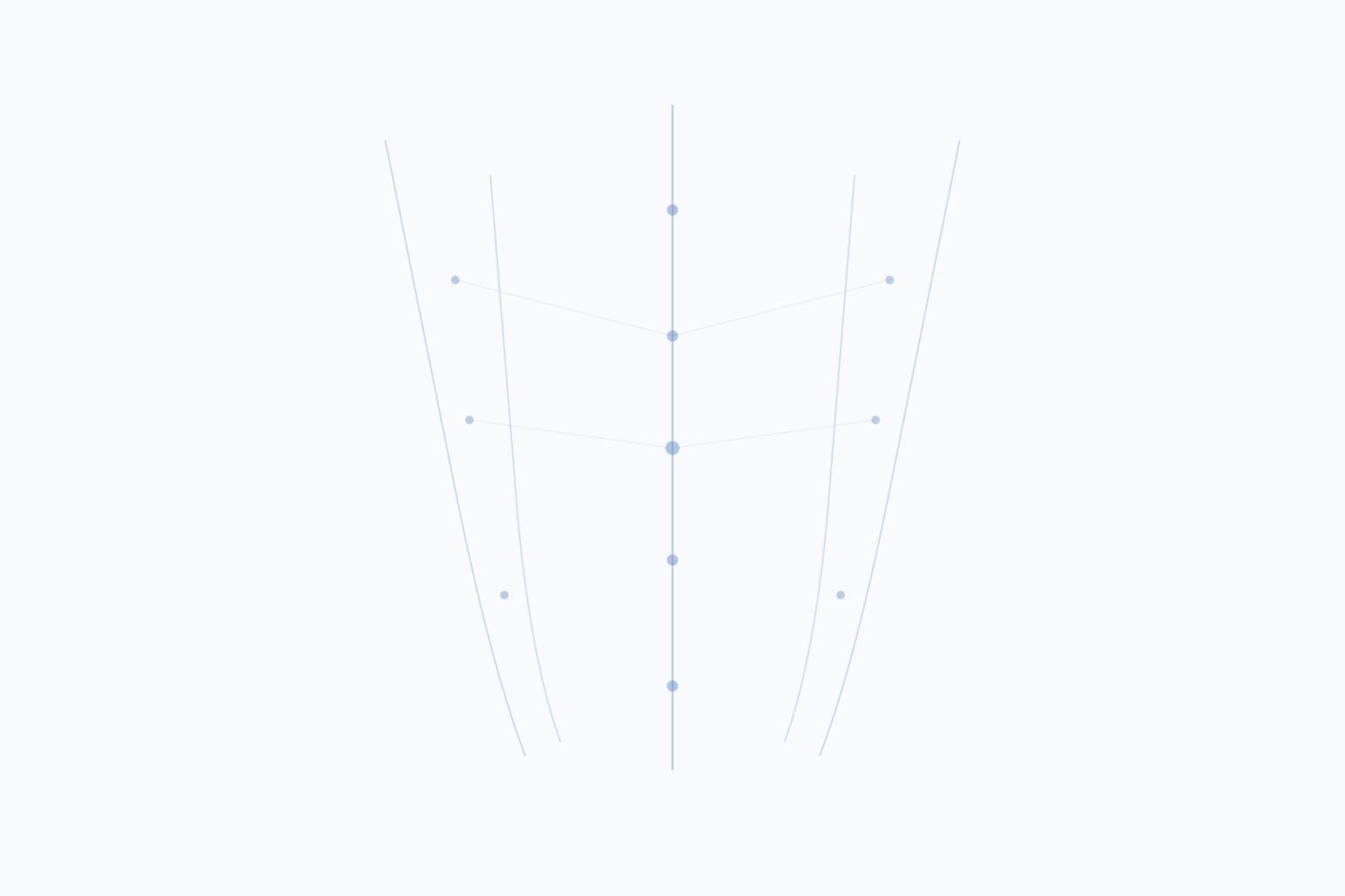
In the first two posts of this series, we established that yin yoga works beyond the physical body, and that stillness and time create the conditions for deeper layers of experience to emerge. One of those layers is at the energetic level. Students often report sensations during sustained holds that do not fit neatly into a muscular or skeletal explanation – a warmth spreading through the inner legs, a tingling along the spine, an unexpected wave of emotion in a hip-opening posture.
These experiences point toward a dimension of the body that Western anatomy has traditionally had little language for, but which Traditional Chinese Medicine (TCM) has mapped in detail for over two thousand years. That map is the meridian system.
What meridians are
In TCM, chi (sometimes written as qi) is understood as the vital energy or life force that sustains all living things. Chi circulates through the body along defined pathways known as meridians, each associated with particular organs and physiological functions. When chi flows freely through these pathways, health is supported – the organs function well, the emotions are balanced, and there is a felt sense of vitality and resilience. When chi stagnates, is depleted, or is obstructed, imbalance follows: physical symptoms, emotional disturbance, and a general sense that something is not quite right.
The meridian system comprises 12 primary channels, each named after the organ it is most closely associated with – the Kidney meridian, the Liver meridian, the Lung meridian, and so on. These are not identical to the organs as understood in Western medicine or anatomy. In TCM, each organ name within the meridian system refers to an entire functional system that encompasses physical, energetic, and emotional dimensions. The Kidney system, for instance, governs not only the kidneys themselves but also the bones, the ears, the reproductive system, and the emotion of fear. This broader understanding is central to how meridian theory informs yin yoga practice.
It is worth noting that the concept of chi does not map precisely onto any single category in Western anatomy or physiology. Practitioners and researchers continue to explore its relationship to the fascial network, the nervous system, and other biological systems. For the yoga practitioner, what matters is that the meridian framework offers a coherent and time-tested way of understanding experiences in the body that a purely physical model cannot fully account for.
How meridians are organised
The 12 primary meridians are organised into six pairs, each consisting of one yin meridian and one yang meridian. The yin meridian in each pair tends to run along the inner or front surfaces of the body and is associated with the more internal, nourishing functions of its organ system. The yang meridian runs along the outer or back surfaces and governs the more active, protective, and eliminative functions. Within each pair, the yin and yang meridians have a complementary relationship – they balance and support one another, and imbalance in one often affects the other.
These pairs are further grouped by the Five Elements of TCM: Water, Wood, Fire, Earth, and Metal. Each element governs a particular organ pair and carries its own set of physical, emotional, and seasonal associations.
For yin yoga practitioners, three element-pairs are especially relevant. Water (Kidney and Urinary Bladder) governs our foundational vitality, our courage, and our relationship with fear. Wood (Liver and Gallbladder) governs the smooth flow of chi throughout the body, our capacity for decisiveness, and our relationship with frustration. Earth (Spleen and Stomach) governs digestion, nourishment, and our tendency toward worry or overthinking. These three pairs are stimulated most directly by the postures that form the backbone of a typical yin yoga sequence – the hip openers, forward folds, and spinal work that target the deep connective tissues of the pelvis, inner legs, and lower back.
Why this matters for yin yoga
Paul Grilley’s early work drew directly on Dr Hiroshi Motoyama’s research into the meridian system to establish a connection between the held postures of yin yoga and the stimulation of specific energetic pathways. The insight is straightforward – the meridians run through the deep connective tissues, and when we apply sustained compression and tension to those tissues through long-held postures, we stimulate the flow of chi through the corresponding meridian pathways. A well-sequenced yin class is therefore not merely stretching the physical body; it is nourishing the energetic body and supporting the conditions for vitality and balance at the level of the whole person.
This also begins to explain why emotions can surface so readily during yin yoga practice. TCM understands emotions as stored in the organs and their associated meridians – fear in the Kidneys, frustration in the Liver, grief in the Lungs, worry in the Spleen. When we hold a posture that targets a particular meridian pathway for several minutes, we may encounter emotional material that has been held along that pathway. The practice does not ask us to analyse or resolve these emotions; it asks us to be present with them, to allow them to surface and move through us. This is one of the ways in which yin yoga bridges the physical and the contemplative – the body becomes the doorway to inner experience.
A framework for deeper inquiry
Meridian theory offers the yoga practitioner a language for experiences that might otherwise feel mysterious or inexplicable: the unexpected tears in Swan pose, the sense of deep calm after a sequence that works the inner leg line, the irritability that surfaces when certain areas of the body are stimulated. It is not the only lens through which these experiences can be understood, but it is a practical and holistic one. In the posts ahead, we will examine the individual meridian pairs – their pathways, their functions, and what it means to work with them on the mat.