Description
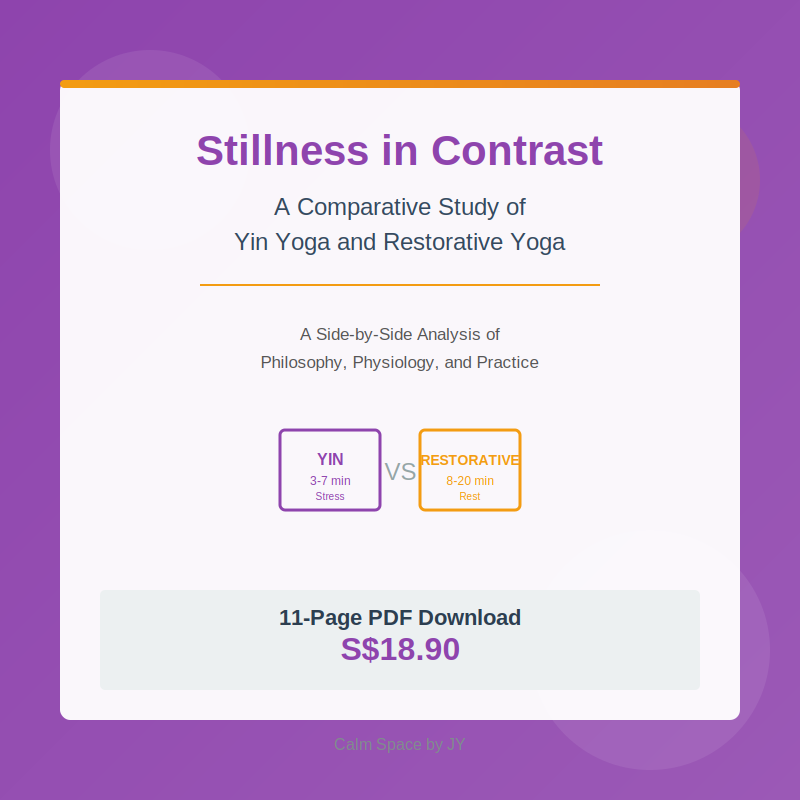
Stillness in Contrast: A Comparative Study of Yin Yoga and Restorative Yoga
A Side-by-Side Analysis of Philosophy, Physiology, and Practice
Yin yoga and restorative yoga are both still and quiet yoga practices – but beneath the surface, they work in fundamentally different ways. This comprehensive comparative study clarifies exactly how these two modalities diverge in intention, physiology, and pedagogy, giving you a framework to understand both practices with precision and confidence.
The Core Question:
Why hold a yin pose for 3-5 minutes versus a restorative pose for 15-20 minutes? Why does yin yoga target moderate sensation while restorative yoga removes all effort? What is actually happening in the body and nervous system during each practice? This resource answers these questions through a rigorous side-by-side analysis based on anatomy, neuroscience, and the lineages of both traditions.
A Complete Comparative Framework:
Yin yoga applies gentle, sustained stress to connective tissues – fascia, ligaments, joint capsules – to build tolerance, mobility, and interoceptive awareness. It functions as active meditation, inviting practitioners to meet mild discomfort with mindful presence. Restorative yoga, by contrast, removes all mechanical stress through prop support, activating the parasympathetic nervous system to promote deep rest, healing, and homeostatic recovery. One conditions through challenge; the other restores through surrender.
What You’ll Learn:
Trace the historical and philosophical foundations of both practices, from Paul Grilley’s functional anatomy and Sarah Powers’ mindfulness integration to Judith Lasater’s therapeutic interpretation of Iyengar’s prop system. Understand the anatomical and physiological mechanisms: how yin yoga stimulates fibroblast activity and fascial remodelling through ‘creep loading’, and how restorative yoga triggers measurable reductions in cortisol, heart rate, and vascular stress through parasympathetic dominance.
Explore the psychological and neurobiological dimensions – yin yoga’s cultivation of vagal flexibility and resilience through awareness in discomfort, versus restorative yoga’s trauma-informed safety cues and polyvagal regulation through complete support. Discover how each practice trains distinct but complementary forms of emotional regulation.
Teaching Applications and Integration Strategies:
This resource goes beyond theory to show you how to teach both modalities effectively. Learn the pedagogical differences: yin yoga’s facilitation of functional self-inquiry versus restorative yoga’s meticulous architecture of ease. Understand when to guide students toward their edge and when to create conditions for total surrender. Discover how to integrate both practices in a ‘yin-to-restore’ sequence that honours the cyclical rhythms of engagement and release.
Includes:
- Historical lineages and philosophical foundations
- Anatomical and physiological mechanisms (fascia, nervous system, tissue adaptation)
- Psychological and neurobiological research evidence
- Pedagogical methods and ethical considerations
- Comprehensive comparison table covering all key dimensions
- Clinical and therapeutic applications
- Future research directions
- Academic bibliography
Whether you are a yoga teacher seeking clarity on when to offer yin versus restorative, a practitioner wondering which practice serves your current needs, or a studio owner designing class schedules, this resource provides the depth and nuance you need to understand both modalities as complementary pathways toward holistic well-being.
Instant PDF download. 11 pages of evidence-based comparative analysis.
Reviews
There are no reviews yet.